The tilt-turn balcony doors, terrace doors and entrance doors on European aluminum systems use a different cylinder from a storefront. Here is how it comes out, the choice between a key and a thumbturn on the inside, how to size it, which security grade to specify, and the three finishes we stock.
In short: European aluminum doors, the tilt-turn balcony doors, terrace doors and entrance doors from Reynaers, Cortizo, Alutech, Kleidco and similar systems, do not use the American mortise cylinder. They use a Euro profile cylinder: a pear-shaped cylinder that slides through the multipoint lock from the edge of the door and is held by one long screw in the lock face. It comes out in two minutes with the door open and a screwdriver. The choices when replacing one: a double cylinder (key both sides), a key and thumbturn (key outside, turn knob inside, which is what we recommend for any door someone has to get out of quickly), or a half cylinder (key one side only); the length, measured from the center screw to each face; security features such as anti-snap and anti-bump; and the finish, brass, gray (satin nickel or chrome) or black. We stock the common sizes in all three finishes and key them alike where a building wants one key for several doors.
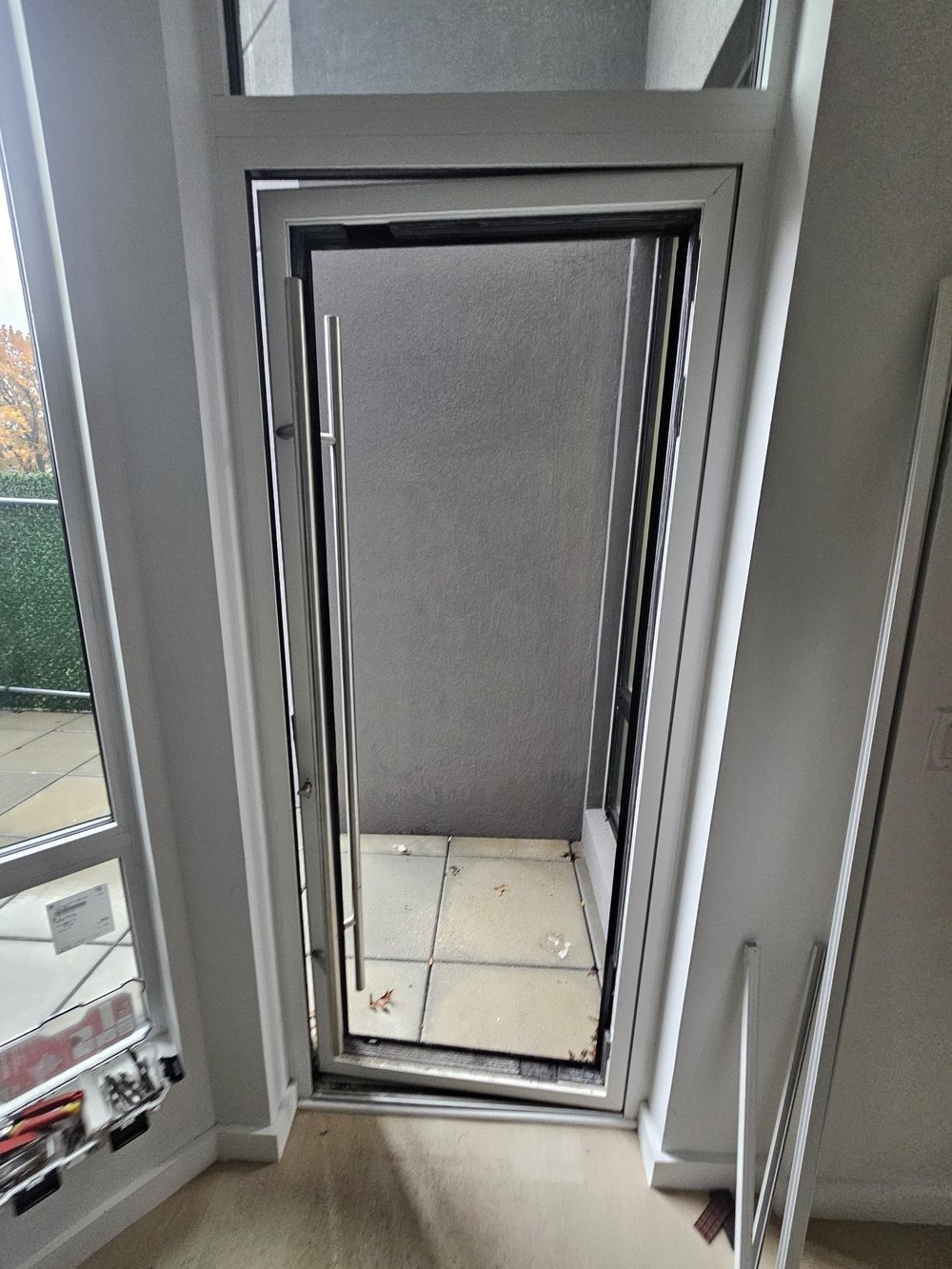
If the door is aluminum or uPVC and the handle turns up to tilt or lift the sash, the lock is a European multipoint and the cylinder is a Euro profile. The keyway sits just below the inside handle, in the long escutcheon plate, and the cylinder body has the characteristic pear section: a round barrel on top and a narrow stem below. On a tilt-turn window there is usually no cylinder at all, just a lockable handle; on a balcony or terrace door and on a residential entrance door there is one. American storefront doors use a different, threaded cylinder; we cover that in how we replace a storefront door cylinder.
This is the first decision and it is about safety as much as convenience.
A Euro cylinder is measured in millimeters from the center of the fixing screw hole to each face: a "35/35" is 35 mm to each side; a "35/45" is 35 mm outside and 45 mm inside, for a door with a thicker inside escutcheon. The right length puts the cylinder face flush with, or at most 2 mm proud of, the escutcheon on both sides. Too long and the cylinder sticks out of the door, which is the single biggest reason Euro cylinders get snapped by burglars; too short and the key cannot be turned through the plate.
To size one: open the door, take out the long screw in the lock face level with the cylinder, slide the cylinder out, and measure it, or measure the door thickness and the depth of each escutcheon and tell us; we carry the common sizes and cut nothing on site. Lengths run from 30/30 to 50/50 in 5 mm steps; on a thick European entrance door with a security escutcheon the inside half is often longer than the outside.
The multipoint lock behind the cylinder is what gives a European door its real security: three to five bolts along the edge, driven by the handle. The cylinder only locks the handle. A good cylinder on a worn multipoint is not secure, so when we change a cylinder on an older door we run the lock through its full travel and adjust the keeps while we are there.
Euro cylinders are made in the same finishes as the door hardware, and the one to choose is the one that matches the handle, not the frame:
We stock all three in the common lengths, in key/thumbturn and double versions. On a job with several doors, cylinders are supplied keyed alike (one key for all) or on a master system (each tenant's key opens their door, the super's key opens all) at the time of order.
On an undamaged door that is a ten-minute job. The cases that need us: a cylinder that has been snapped or drilled, a door where the multipoint lock no longer throws, a snapped key, a size or keyway nobody can identify, or a building that wants the doors keyed alike or mastered. To make it one visit, schedule a service call with a photo of the inside handle and escutcheon, a photo of the door edge with the lock face, and the door thickness; we bring the right length, function and finish. We do this across the five boroughs, Long Island and New Jersey on the Reynaers, Cortizo, Alutech and Kleidco doors we install and on other makers' doors too.
The pear-shaped lock cylinder used in European multipoint locks on aluminum, uPVC and wood doors. It slides into the lock from the door edge and is held by one screw; it is not interchangeable with the threaded mortise cylinder of an American storefront door.
A thumbturn inside lets anyone leave without a key, which is what an exit door should do; we recommend it for terrace, balcony and entrance doors. A double (key/key) cylinder is chosen where a child must be kept off a balcony or where glass near the lock could be broken to reach a thumbturn, and only on doors that are not the sole exit.
From the center of the fixing screw hole to each face, in millimeters, e.g. 35/45. The faces should sit flush with the escutcheons; a cylinder that sticks out can be snapped.
Brass, gray (satin nickel, chrome or stainless look) and black, to match the handle set. We stock all three.
A cylinder with a breakaway front section so that if a burglar snaps it, the lock stays secure. Combined with a security escutcheon it is the standard protection on European entrance doors.
Yes. Cylinders are supplied keyed alike or on a master-key system at the time of order; tell us the number of doors and who needs which access.
On an undamaged door, yes, in about ten minutes with a screwdriver: remove the faceplate screw level with the cylinder, align the cam with the key and slide the cylinder out, slide the new one in and refit the screw. Call us if the cylinder or lock is damaged, a key is broken off, or the doors need to be keyed alike.
Usually not. If the handle will not lift the bolts or they do not reach the keeps, the multipoint lock or the keeps need adjustment or replacement; we check the lock travel whenever we change a cylinder.
Replacing a storefront door cylinder Balcony and terrace doors Residential entrance doors Tilt-turn windows Window and door hardware Entrance door final alignment
About this page. Written by Alex GC Inc. d/b/a Alex Glass Construction and reviewed before publication by Aleksandr Chernovolenko, Managing Partner, with our design and estimating lead and a field foreman. Our foremen hold the NYC DOB Site Safety Training supervisor card and our crews the 40-hour worker card; we are certified to fabricate, install and service Alutech and Everest aluminum systems. Facts are drawn from our own projects, manufacturer test data and the applicable codes; where we are giving an opinion, we say so. Last reviewed November 2026. Credentials
Send a photo of the inside handle, a photo of the door edge at the lock and the door thickness. We will bring the right length, key or thumbturn, and finish in one visit, keyed alike if you have several doors.